Earth, our systems, adaptive range
The Line Between Growth and Collapse
By now, most of us have realized our environment isn’t exactly our biggest fan.
And we all have theories about why.
I’d like to share mine—because I think we’re asking the wrong question.
The Wrong Question
The question isn’t “Can we save Earth?”
It’s “Can we maintain the conditions we need to survive?”
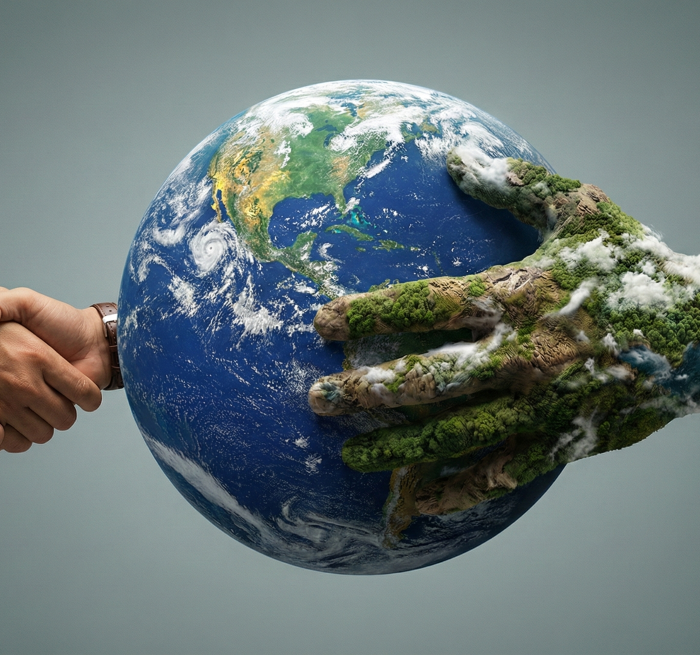
For most of human history, we assumed Earth could handle everything we threw at it—materials extracted, waste deposited, systems built.
That assumption held because Earth processed consequences faster than they accumulated.
Then we crossed a threshold.
Understanding Earth’s Adaptive Range
Earth’s adaptive range is wide. But the zone within it that supports human survival?
Much narrower. And we’ve pushed outside it.
The environment didn’t become fragile. It reached the limits of what it could absorb.
Listen: Earth Isn’t Dying. Earth Responds to Causality.
Here’s what we actually know:
Earth is ancient.
It has existed before and realigns to new stable states.
We know OUR adaptive range.
Biology gives us precise survival thresholds—temperature ranges, oxygen levels, water availability, food system stability.
Earth operates on time delay.
Changes take time to unfold, and longer to reverse.
We don’t know Earth’s exact boundaries, but we know our survival depends on Earth staying within the conditions we need.
The Task: Alignment
The task before us is straightforward:
1. Reduce those disruptions systematically and at scale
2. List the conditions we need for human survival and thriving
3. Identify what disrupts them (GHG emissions, biodiversity loss, freshwater depletion, soil degradation)
Where Our Agency Matters Most
We know what we’re doing that disrupts the conditions we need. GHG emissions top the list. That knowledge is valuable—because we can alter what we’re causing.
Every bit, and every beat counts.
The Caveat
This window isn’t permanent or wide.
Changes already in motion will take time to reverse—but only if we act now.
Wait too long, and we’re managing consequences instead of preventing them.
The difference between those two paths is everything.
We’re Not Saving Earth. We’re Saving the Conditions We Need.
This reframe matters.
Earth will continue. It will find new stable states. It always has.
The question is whether those new states include the narrow band of conditions that allow human civilization to function.
That’s what’s at stake.
The Goal: A Compatibility Zone
A Compatibility Zone is where Earth reaches its new stable state while still providing the conditions for our survival.
It’s not about returning to some idealized past.
It’s about aligning our systems—economic, industrial, social—with the reality of Earth’s regenerative capacity and the boundaries of our survival range.
Adaptive Range Is the Line
To cross or not to cross.
On one side, growth. On the other, collapse or transformation.
That’s the choice.
And right now, we’re on the collapse side of the line, accelerating.
But transformation is still possible—if we understand what needs to transform, why, and how to do it without breaking the systems we depend on in the process.
The Integration Challenge
This is where it gets complex.
Most organizations, industries, and economies are designed to grow by extracting more, producing more, consuming more.
That model worked within Earth’s adaptive range—when consequences could be absorbed faster than they accumulated.
But we’re outside that range now.
Growth as we’ve practiced it is no longer compatible with the conditions we need to survive.
That doesn’t mean all growth is impossible. It means growth must be redefined:
- Not “how much can we take?” but “how do we operate regeneratively?”
- Not “how do we scale extraction?” but “how do we scale reciprocity?”
- Not “how fast can we grow?” but “how can we grow within the compatibility zone?”
What Comes Next
The next post will explore something unprecedented: for the first time in human history, transformation designed for mitigation opens an inevitable market.
Not a niche market. Not a conventional value-driven market. It will be a bidirectional value-driven market.
An inevitable one.
Because markets follow need.
And humanity needs to operate within the compatibility zone.
Understanding that changes everything about how we approach transformation—and why examined transformation is the only kind that will work.